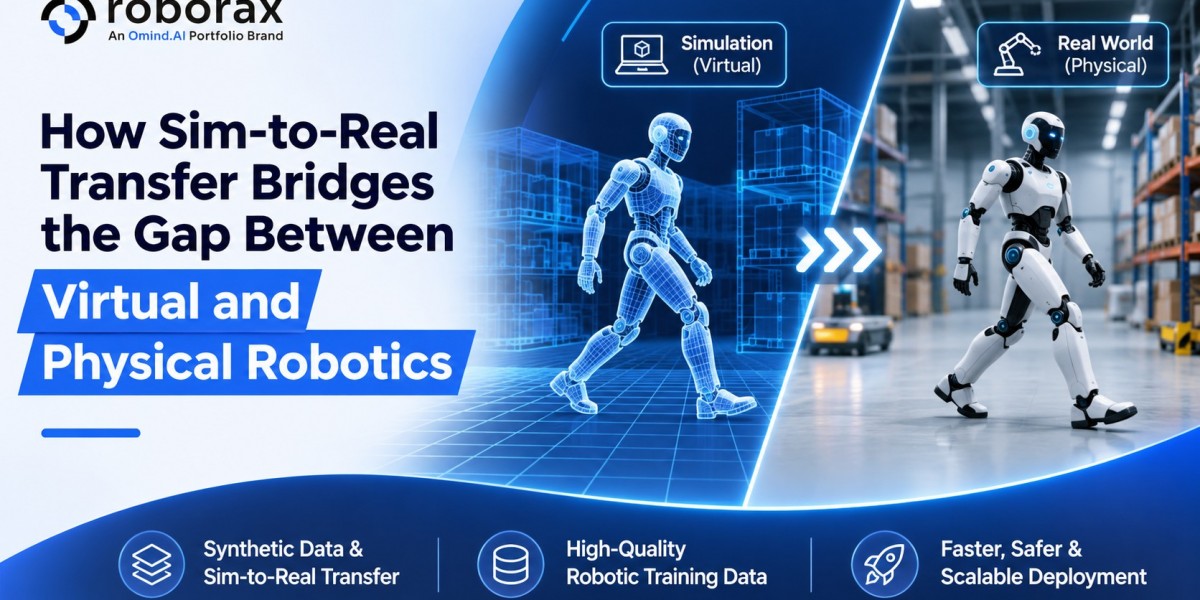

Robotics has advanced significantly with the development of artificial intelligence, machine learning, and advanced simulation technologies. However, one major challenge remains: enabling robots trained in virtual environments to perform reliably in the physical world. While simulations offer controlled, scalable, and cost-effective environments for developing robotic capabilities, real-world deployment introduces unpredictable conditions that are difficult to reproduce digitally. This challenge makes sim-to-real transfer an essential part of modern robotics development.
Sim-to-real transfer refers to the process of transferring knowledge, skills, and behaviors learned in simulated environments to physical robotic systems. By combining simulation technologies, robotic training data, and real-world validation, robotics developers can reduce training costs, improve adaptability, and accelerate deployment.
At Roborax, we recognize the importance of building reliable training pipelines that connect virtual experimentation with physical robot performance. Understanding how synthetic data & sim-to-real transfer work together is critical to developing scalable robotics systems.
What Is Sim-to-Real Transfer in Robotics?
Sim-to-real transfer is a technique that enables robots to apply skills learned in computer-generated environments to real-world tasks. Instead of relying entirely on physical robot interactions, developers first train robotic models in simulated environments that replicate real-world objects, environments, movements, and physical interactions.
For example, a robotic arm can learn object picking and placement in a virtual warehouse before performing the same task using physical equipment. Simulation allows developers to experiment with different object shapes, lighting conditions, obstacle arrangements, and movement patterns without risking hardware damage.
However, virtual environments cannot perfectly reproduce physical reality. Differences in friction, sensor accuracy, material properties, lighting, and mechanical behavior can affect robotic performance after deployment.
Sim-to-real transfer addresses these differences by preparing robotic models to handle variations between simulated and physical environments.
Why Is the Gap Between Virtual and Physical Robotics Challenging?
Although simulation provides an effective training environment, transferring learned behaviors into physical systems involves several technical challenges.
1. Differences in Physics and Dynamics
Virtual environments use mathematical models to simulate gravity, friction, collision, and movement. However, these models may not perfectly represent real-world physical interactions. A robot trained to grasp an object in simulation may struggle with the same object physically because of variations in weight, surface texture, or friction.
2. Sensor and Perception Variations
Robots depend on cameras, LiDAR, depth sensors, and other perception systems to understand their surroundings. Simulated sensors often produce cleaner and more predictable outputs than physical sensors, which can experience noise, reflections, occlusion, and calibration errors.
3. Environmental Unpredictability
Real-world environments continuously change. Lighting conditions, moving objects, unexpected obstacles, and variations in object positioning can influence robotic decisions. Simulated environments must account for these variations to prepare robots for deployment.
4. Differences in Robot Hardware
Even small differences in actuator performance, mechanical structures, and joint calibration can influence how a robot behaves. A control policy that performs well on a simulated robot may require adjustments before working effectively on physical hardware.
How Synthetic Data Supports Sim-to-Real Transfer
Synthetic data plays a significant role in improving the effectiveness of sim-to-real transfer. It allows developers to generate large volumes of artificial training examples using simulation platforms without collecting every data point through physical robot operations.
These datasets can include images, depth maps, point clouds, object poses, segmentation masks, motion trajectories, and sensor measurements.
Here are some important ways synthetic data strengthens robotics training:
1. Generating Diverse Training Scenarios
Simulation platforms can create thousands of environmental variations by modifying lighting, textures, object positions, backgrounds, and obstacles. This diversity helps robotic models learn to recognize objects and navigate unfamiliar situations.
2. Improving Perception Accuracy
Synthetic visual datasets can provide pixel-level segmentation, bounding boxes, depth information, and object identification labels. These annotations help perception models understand their surroundings more accurately.
3. Training for Rare and Complex Situations
Some real-world situations are difficult, expensive, or unsafe to reproduce repeatedly. Simulation makes it possible to generate scenarios involving unexpected obstacles, collisions, unusual object orientations, and challenging environmental conditions.
4. Reducing Data Collection Costs
Physical robot data collection requires equipment, operational space, maintenance, and human supervision. Synthetic data reduces dependence on continuous hardware-based collection while allowing developers to expand their training datasets.
When combined with carefully designed robotic training data, synthetic datasets provide a stronger foundation for transferring learned capabilities into physical environments.
Key Techniques That Improve Sim-to-Real Transfer
Successful sim-to-real transfer requires more than creating realistic virtual environments. Developers use several techniques to reduce the differences between simulated and physical conditions.
Domain Randomization
Domain randomization involves introducing controlled variations into simulation environments. Developers modify lighting, object textures, camera positions, friction, mass, and other physical parameters during training.
By exposing robotic models to diverse conditions, domain randomization encourages them to learn adaptable behaviors rather than relying on a single simulated environment.
System Identification
System identification involves measuring the physical characteristics of a real robot and adjusting its simulated counterpart accordingly. Parameters such as actuator response, joint dynamics, and friction are calibrated to make the simulation more representative of actual hardware.
Domain Adaptation
Domain adaptation techniques help machine learning models handle differences between simulated and real-world data distributions. These methods can improve perception performance when transferring models trained on synthetic images to physical camera inputs.
Real-World Fine-Tuning
After initial simulation-based training, developers can collect physical robot demonstrations and operational feedback to refine model behavior. This additional training helps address inaccuracies that simulation alone cannot eliminate.
Combining these approaches creates a more reliable transfer pipeline.
The Importance of High-Quality Robotic Training Data
Even the most sophisticated simulation environment cannot guarantee successful deployment without accurate and diverse training datasets. Data quality directly influences how effectively robotic models recognize objects, interpret sensor inputs, and execute physical actions.
For example, an autonomous mobile robot trained using inaccurate obstacle boundaries may make incorrect navigation decisions. Similarly, inconsistent object pose annotations can affect a robotic arm's ability to grasp and manipulate objects.
High-quality robotic training data should include:
Accurate object detection and segmentation labels.
Consistent 2D and 3D bounding box annotations.
Precise object positioning and orientation information.
Multimodal sensor data from cameras, LiDAR, and depth sensors.
Motion trajectories and action-related annotations.
Human-reviewed labels and quality assurance checks.
Human validation is particularly valuable when synthetic datasets contain incorrect labels or unrealistic representations. Reviewing training examples helps identify inconsistencies before they affect model performance.
Roborax supports robotics development through data-focused capabilities that help teams build structured, reliable datasets for intelligent robotic systems.
Real-World Applications of Sim-to-Real Transfer
Sim-to-real transfer is becoming increasingly valuable across different robotics applications.
Humanoid Robotics: Humanoid robots can learn walking, balancing, object manipulation, and coordinated movements through simulation before performing these activities in physical environments.
Warehouse and Logistics: Autonomous mobile robots can practice navigation, obstacle avoidance, inventory movement, and object handling in virtual warehouse environments before deployment.
Industrial Robotics: Robotic arms can learn assembly, picking, sorting, and material-handling operations through simulated scenarios, reducing the need for extensive physical experimentation.
Autonomous Robotics: Robots operating outdoors can use simulation-generated training scenarios to prepare for changing terrain, dynamic obstacles, and environmental variations.
These applications demonstrate how simulation-based learning can accelerate robotics development while improving operational readiness.
How Roborax Supports the Future of Sim-to-Real Robotics
Building reliable robotics systems requires more than advanced simulation software. It requires structured datasets, accurate annotations, diverse training scenarios, and continuous validation between virtual and physical environments.
Roborax focuses on supporting robotics development through data-driven capabilities that contribute to robotic learning and deployment workflows. From synthetic dataset preparation to perception-oriented training data and real-world validation support, high-quality data plays an important role in reducing the gap between simulation and physical execution.
By emphasizing dataset diversity, annotation consistency, and quality assurance, robotics teams can develop training pipelines that better prepare intelligent machines for real-world challenges.
Conclusion
Sim-to-real transfer is transforming how intelligent robots are trained, tested, and deployed. By combining realistic simulations, synthetic data generation, domain randomization, and real-world fine-tuning, developers can reduce the limitations associated with traditional hardware-dependent training.
However, successful transfer ultimately depends on the quality of the data used throughout the development process. Accurate robotic training data helps bridge the differences between virtual representations and physical environments, enabling robots to become more adaptable and reliable.
As robotics continues to evolve, the combination of synthetic data & sim-to-real transfer will remain essential for developing scalable, intelligent, and deployment-ready robotic systems. Roborax aims to support this evolution by helping robotics teams build stronger data foundations for the next generation of intelligent machines.