
Intelligent robots are evolving beyond pre-programmed machines that perform repetitive tasks. Modern robots are expected to understand their surroundings, interpret human actions, make independent decisions, and adapt to unpredictable environments. From warehouse automation and industrial manufacturing to healthcare and autonomous systems, these capabilities depend on how effectively robots learn from real-world data.
However, teaching a robot what to do is only one part of the process. Robots must also learn how to behave in different situations, respond to environmental changes, and select appropriate actions based on their observations. This is where behavioral annotation becomes essential.
Behavioral annotation involves labeling and structuring information about actions, movements, interactions, and decision-making patterns to help AI systems understand and reproduce meaningful behaviors. By converting raw sensor recordings and demonstrations into structured training datasets, robotic data annotation services help developers build more adaptive and reliable robotic systems.
What Is Behavioral Annotation in Robotics?
Behavioral annotation is the process of identifying, categorizing, and labeling actions and behavioral patterns demonstrated by humans, robots, or objects within an environment.
Unlike traditional object annotation, which focuses on identifying objects and their locations, behavioral annotation concentrates on understanding what an entity is doing, how it performs an action, and how that action relates to its surroundings.
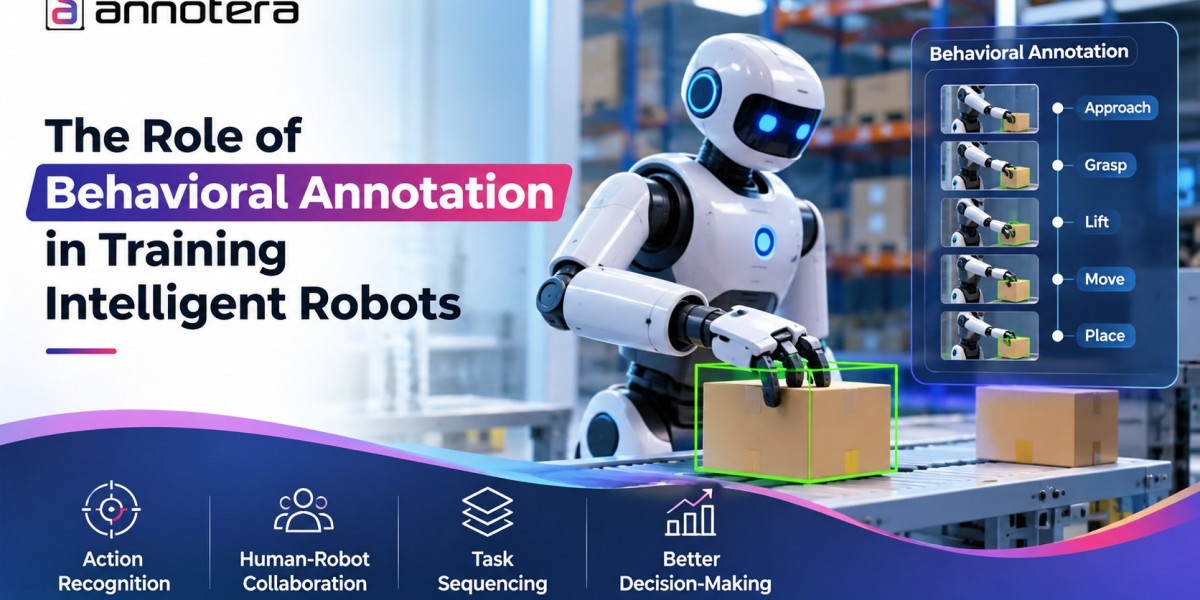
For example, a warehouse robot picking up a package needs more than object identification. It must understand the sequence of actions involved, including approaching the package, positioning its robotic arm, adjusting its grip, lifting the object, and placing it in the designated location.
Behavioral annotation captures these action sequences and contextual relationships, enabling machine learning models to understand task execution rather than simply recognize objects.
Common behavioral annotation categories include:
Action Recognition: Identifying activities such as walking, lifting, pushing, grasping, and placing.
Motion Tracking: Labeling movement patterns, trajectories, and changes in position.
Human-Robot Interaction: Annotating communication, gestures, physical interactions, and collaborative activities.
Task Sequencing: Identifying the order of actions required to complete a specific task.
Behavioral State Classification: Categorizing states such as idle, active, approaching, manipulating, and recovering from failure.
Why Behavioral Annotation Matters for Intelligent Robots
Robots operating in dynamic environments must continuously interpret information and make decisions. Behavioral annotation provides structured examples that help AI models connect observations with appropriate actions.
Here are five important ways it contributes to robotic intelligence.
1. Improves Action Recognition and Decision-Making
Robots need to recognize different actions before determining how to respond. For instance, a collaborative robot working alongside humans must distinguish between someone reaching for a tool, moving an object, or entering its operational workspace.
Behavioral annotation helps classify these activities using labeled video, motion capture, and sensor data. These annotations provide training examples that allow machine learning models to recognize actions and understand their context.
As a result, robots can make more informed decisions instead of relying entirely on predefined instructions.
2. Enables Better Human-Robot Collaboration
Human-robot collaboration requires machines to understand human movements, intentions, and behavioral cues.
Consider an industrial environment where a worker and a robotic arm share a workstation. The robot must recognize when the worker approaches, identify potential interference, and adjust its movements accordingly.
Annotated behavioral datasets help train models to recognize gestures, movement patterns, and interaction sequences. This improves coordination and supports safer collaboration.
High-quality behavioral annotation is particularly valuable for collaborative robots (cobots), service robots, and assistive robotic systems.
3. Strengthens Learning Through Demonstrations
Robots increasingly learn through human demonstrations rather than relying exclusively on manually programmed instructions.
In imitation learning, human operators demonstrate specific tasks while cameras, motion sensors, and robotic systems capture their movements. These demonstrations are then converted into structured datasets through behavioral annotation.
For example, when a human demonstrates how to assemble a component, annotators can identify individual actions, movement sequences, object interactions, and task completion states.
This enables AI models to learn not only the final outcome but also the sequence of actions required to achieve it.
4. Helps Robots Adapt to Dynamic Environments
Real-world environments are rarely predictable. Objects may change positions, people may move unexpectedly, and operational conditions may shift during task execution.
Behavioral annotation helps train robots using diverse scenarios, including unexpected movements, interrupted tasks, failed interactions, and recovery sequences.
By learning from these examples, robotic systems can develop better contextual awareness and improve their ability to respond to changing conditions.
This capability is particularly important for warehouse automation, autonomous navigation, healthcare robotics, and mobile manipulation.
5. Supports Error Detection and Behavioral Optimization
Understanding incorrect actions is just as important as learning successful behaviors.
Behavioral annotation can identify unsuccessful grasping attempts, incorrect movement sequences, collisions, delayed responses, and incomplete tasks.
These labels help developers understand why a robot failed and identify opportunities to improve its training datasets.
When integrated into reinforcement learning and evaluation workflows, annotated behavioral data can support more effective model optimization and continuous performance improvement.
Key Data Types Used in Behavioral Annotation
Effective behavioral annotation often requires combining multiple data sources to capture different dimensions of robotic activity.
The most common data types include:
Video Data: Captures human activities, robotic movements, object interactions, and task execution.
Motion Capture Data: Records joint positions, body movements, trajectories, and movement patterns.
LiDAR and Depth Data: Provides spatial information about objects, obstacles, and environmental changes.
IMU Data: Captures acceleration, orientation, and angular velocity to understand movement dynamics.
Robot Sensor Data: Records joint states, gripper positions, force feedback, and operational status.
Combining these sources enables more comprehensive behavioral datasets, particularly for robots that must coordinate perception, movement, and action.
The Role of Behavioral Annotation in Physical AI Training
Physical AI training focuses on developing intelligent systems that interact with and operate within the physical world. Unlike conventional AI applications that primarily process digital information, Physical AI systems must perceive environments, understand physical relationships, and execute actions.
Behavioral annotation provides the structured supervision required to connect perception with action.
For example, a mobile manipulation robot must recognize an object, determine how to approach it, select an appropriate grasp, and execute the movement without damaging surrounding objects.
Annotated demonstrations help models learn these interconnected processes.
Behavioral datasets also support imitation learning, reinforcement learning, robotic policy development, and multimodal model training. When combined with high-quality sensor synchronization and consistent labeling standards, they help create more representative training datasets.
For organizations developing next-generation robotic systems, investing in reliable annotation workflows is therefore an important part of building capable Physical AI models.
How Annotera Supports Behavioral Annotation for Robotics
Developing intelligent robots requires more than collecting large volumes of sensor data. It requires accurately structured datasets that reflect real-world actions, interactions, and environmental conditions.
Annotera supports AI development teams with specialized data annotation capabilities designed to address the evolving requirements of robotics and Physical AI.
Our robotic data annotation services can support workflows involving:
Action and Activity Labeling: Structuring human and robotic actions into meaningful behavioral categories.
Motion and Trajectory Annotation: Labeling movement patterns, object trajectories, and spatial relationships.
Multimodal Sensor Annotation: Working with synchronized video, LiDAR, depth, and other sensor data.
Human-Robot Interaction Annotation: Labeling collaborative activities, gestures, and interaction sequences.
Quality Assurance: Applying annotation guidelines and review processes to improve consistency and dataset reliability.
By combining structured annotation workflows with quality-focused validation, Annotera helps robotics teams prepare training data for advanced machine learning applications.
Conclusion
Behavioral annotation is becoming a critical component of intelligent robotics development. It enables robots to learn from demonstrations, recognize complex actions, understand interactions, and respond more effectively to changing environments.
As robotics moves toward more autonomous and adaptive systems, the demand for structured, diverse, and accurately labeled behavioral datasets will continue to grow.
Organizations investing in robotic data annotation services can establish stronger data foundations for intelligent automation and Physical AI development.
At Annotera, we believe that better robotic intelligence begins with better training data. Our annotation capabilities help AI teams transform complex real-world observations into structured datasets that support the next generation of intelligent robots.
Ready to strengthen your robotics training datasets? Connect with Annotera to explore scalable data annotation solutions for your next-generation robotics and Physical AI projects.