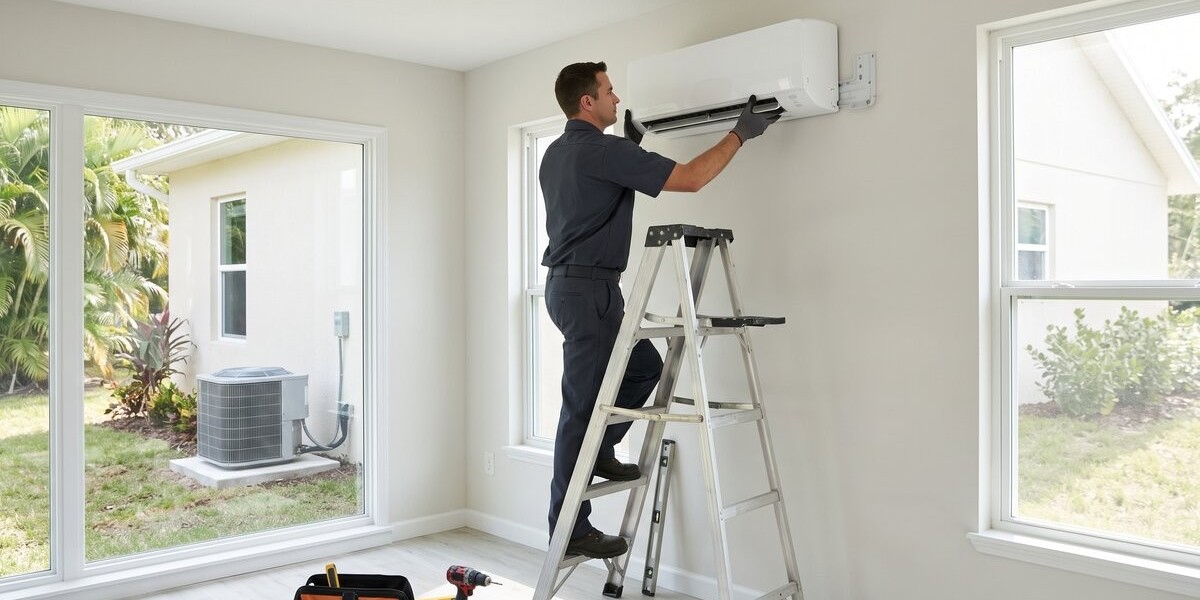

Roman's Service Cooling & Heating installs ductless mini-split systems across Sarasota County, from North Port and Venice to Sarasota itself. Each indoor unit runs on its own thermostat, Daikin and Gree are among the ten brands on offer, and installs carry the company's 12-year parts and labor warranty.
This article starts with the room, not the equipment: where a mini-split beats extending central air, how to choose between single-zone and multi-zone, and why sizing matters more here than almost anywhere else.
At a Glance
| Service | Ductless mini-split installation, single-zone and multi-zone |
|---|---|
| Area | Sarasota County, including North Port, Venice, Nokomis, Osprey, Englewood and Sarasota; also Charlotte and Manatee counties |
| Brands | Daikin and Gree among ten brands installed |
| Warranty | 12 years on parts and labor |
| Financing | 0% for 6, 12 or 15 months; 180-month plan at 11.99% APR; on approved credit |
| Phone | (941) 877-5976, 24/7 |
| Shop | 2735 Commerce Pkwy, North Port, FL 34289 |
How a Mini-Split Works
A ductless mini-split has two parts. An outdoor compressor sits on a pad or wall bracket, and one or more slim indoor units mount high on the wall. A thin conduit carries refrigerant lines, power and the condensate drain between them, usually through a hole about three inches across.
With no ductwork, there is nowhere for cooled air to leak before it reaches the room. In older Florida homes, duct runs through hot attics can lose a meaningful share of cooling, so going ductless removes that loss entirely for the rooms it serves.
Rooms Where a Mini-Split Beats Central Air
Extending central air into a new space means more ductwork, often a bigger system, and a room that still fights the rest of the house for airflow. A mini-split avoids all three. These are the rooms where it makes the most sense.
- Converted garage. A garage turned into a gym, office or guest room rarely has ducts, and its uninsulated door and slab make it hotter than the rest of the house.
- Sunroom or enclosed lanai. Glass walls on three sides overwhelm a central system. A dedicated unit handles that load on its own.
- Addition. New square footage often exceeds what the existing central system can carry.
- Backyard studio or workshop. A detached building is far from the main system, and running ducts to it is not practical.
- Older homes without ductwork. Some older Florida houses were built with window units or none at all. Ductless is the least invasive way to add central-quality cooling.
- The room that is always too hot. A west-facing bedroom or a bonus room over the garage can get its own unit instead of forcing the whole house colder.
Single-Zone vs Multi-Zone
A single-zone system pairs one outdoor unit with one indoor unit. It is the simplest and most common choice for a garage, a sunroom or one problem room.
A multi-zone system connects several indoor units to one outdoor compressor. Each zone has its own thermostat, so a bedroom can sit at 72 while an unused guest room stays warmer. That is where the energy savings come from: you stop paying to cool empty rooms.
| Single-zone | Multi-zone | |
|---|---|---|
| Indoor units | One | Two or more |
| Outdoor units | One | One shared |
| Typical use | Garage, sunroom, one room | Addition with several rooms, whole house without ducts |
| Control | One thermostat | Separate thermostat per room |
| Main trade-off | Simple, one room only | One outdoor unit means one point of failure for all zones |
Why Sizing Matters in a Humid Climate
Sizing is where a mini-split install succeeds or fails. An oversized unit cools the room quickly, reaches the set point, and shuts off. Because it runs in short bursts, it never runs long enough to pull moisture out of the air. The room hits 74 degrees but feels clammy, and in Sarasota County's humidity that can mean musty smells and mold on cool surfaces.
Before quoting, Roman's Service mini-split installation crews measure each room and pick single-zone or multi-zone capacity to match. Daikin and Gree are among the ten brands on offer, and the 12-year parts and labor warranty covers ductless installs.
The measurement takes more than square footage. Ceiling height, window area and orientation, insulation, and how the room is used all change the load. A sunroom with west-facing glass needs far more capacity per square foot than an interior bedroom.
Placement matters too. Indoor units go where the air can spread evenly across the room without blowing directly on a bed or desk. The outdoor unit needs clearance for airflow and access for service.
Heating Mode for Cool Nights
Mini-splits are heat pumps, so the same equipment that cools in August warms the room on a cool January night. In Southwest Florida, that is usually all the heating a sunroom or garage office needs. Heat pumps move heat rather than generate it, which makes them more efficient than electric space heaters or resistance heat strips.
Living With a Mini-Split
Ductless systems run quietly, with the loudest parts outside. Indoor units use washable filters that should be rinsed regularly, more often in homes with pets. Roman's Service notes that its technicians clean and check those filters, inspect the refrigerant lines and the outdoor condenser, and test every zone during maintenance visits. Salt air near the coast makes that outdoor inspection more important.
For homeowners who want two scheduled visits a year, the company's maintenance plan covers spring and fall tune-ups, with same-day or next-day priority for repairs and 15% off repair parts and labor.
Questions to Ask Any Mini-Split Installer
Whoever you hire, a short list of questions shows quickly whether the quote was built for your room or copied from a price sheet.
- How did you size it? The answer should mention the room's windows, orientation and insulation, not just its square footage.
- Where will the indoor unit go, and why there? A good installer explains the airflow pattern and avoids blowing straight onto a bed or desk.
- Where does the condensate drain? In a humid climate, a mini-split removes a lot of water. It needs a proper drain path or a pump, not a tube dripping onto the lanai.
- How long is the line set, and how will it be covered? A neat cover on the exterior wall protects the lines from sun and looks better.
- What does the warranty cover? Ask about parts and labor separately, and get both in writing.
The U.S. Department of Energy's Energy Saver pages on ductless mini-split heat pumps are a good neutral reference before you compare quotes.
FAQ
Can a mini-split handle Florida humidity?
Yes, if it is sized correctly. A properly sized unit runs long enough to dehumidify. Many models also have a dry mode for mild, muggy days.
Will it heat in winter?
Yes. Mini-splits are heat pumps and switch to heating on cool nights.
Do I need a permit?
Most Florida jurisdictions require a permit for new HVAC equipment. Ask your installer to confirm and to pull it.
Can I add a mini-split alongside my central AC?
Yes. That is one of the most common uses, for a room the central system cannot keep comfortable.
For a garage, lanai or addition in Sarasota County, a correctly sized mini-split is often the cleanest answer. Call (941) 877-5976 to book a measurement visit.



